Geographic Context Collapse: How AI Search Engines Forget Where You Are
Three European brands in three sectors collapsed in GPT-5.3 on the same day, while US brands held. A three-week EchoWi study of a new LLM failure mode.

TL;DR: On March 19, 2026, three European brands across three sectors and two countries collapsed simultaneously in GPT-5.3’s AI visibility. A French fintech lost 42%. A Spanish motorcycle marketplace lost 60%. A Spanish health brand lost 93%. That same day, a US data science platform hit its all-time high. Our three-week investigation uncovered a phenomenon we call Geographic Context Collapse, and it affects every brand operating outside the United States.
The moment AI forgot about France
It was a Wednesday. I was scrolling through our monitoring dashboard at EchoWi, coffee going cold, when a data point made me stop mid-sip.
We’d asked GPT-5.3 a simple question in French: “Quelles sont les meilleures alternatives a la Societe Generale pour une petite entreprise?”. “What are the best alternatives to Societe Generale for a small business?”
Societe Generale. One of France’s oldest, largest banks. The question was in French. The entities were French. Every signal screamed France.
The AI recommended Chase, Bank of America, Wells Fargo, Citibank, and U.S. Bank.
Five American banks. For a French small business owner. In response to a French-language question about a French bank.
I stared at it. Then I ran it again. Same thing.
This wasn’t a glitch. At EchoWi, we track and optimize how brands, products and people surface in AI search responses, every day, across 100+ prompts per workspace, for every account we work with. We’ve got eyes on these models like a hawk. And on March 19, 2026, we watched an entire brand’s AI presence fall off a cliff. Overnight.
But here’s the thing that turned a bad day into a three-week obsession: it wasn’t just one brand.
What we found: Qonto’s invisible cliff
Qonto is France’s leading neobank for businesses, 600,000+ customers, operating across 8 European markets, EUR 449 million in revenue. This isn’t some scrappy startup. It’s a major player in European business banking.
We track Qonto’s visibility across 100+ daily prompts. The kind of questions a real human might type into ChatGPT when thinking about business banking in France. Stuff like “How to open a business account without a traditional bank in France?” or “Which digital banks are best for French entrepreneurs?” Normal questions. The kind being asked thousands of times a day.
For the first 18 days of March, everything looked fine. Qonto was cruising: 36-44% visibility (showing up in roughly 4 out of 10 queries), sitting at position 1.3-2.5 on average (frequently the #1 recommendation), and pulling consistently positive sentiment scores between 0.6 and 0.8.
Then March 19 hit. And the floor vanished.
The data
| Date | Visibility | Qonto mentions | French brands mentioned | US brands mentioned |
|---|---|---|---|---|
| March 16 (peak) | 44% | 44 | 54 | 12 |
| March 18 | 36% | 36 | 44 | 2 |
| March 19 | 20% | 20 | 30 | 66 |
| March 21 (trough) | 12% | 12 | 26 | 48 |
Look at that US brands column again. From 2 to 66 in a single day.
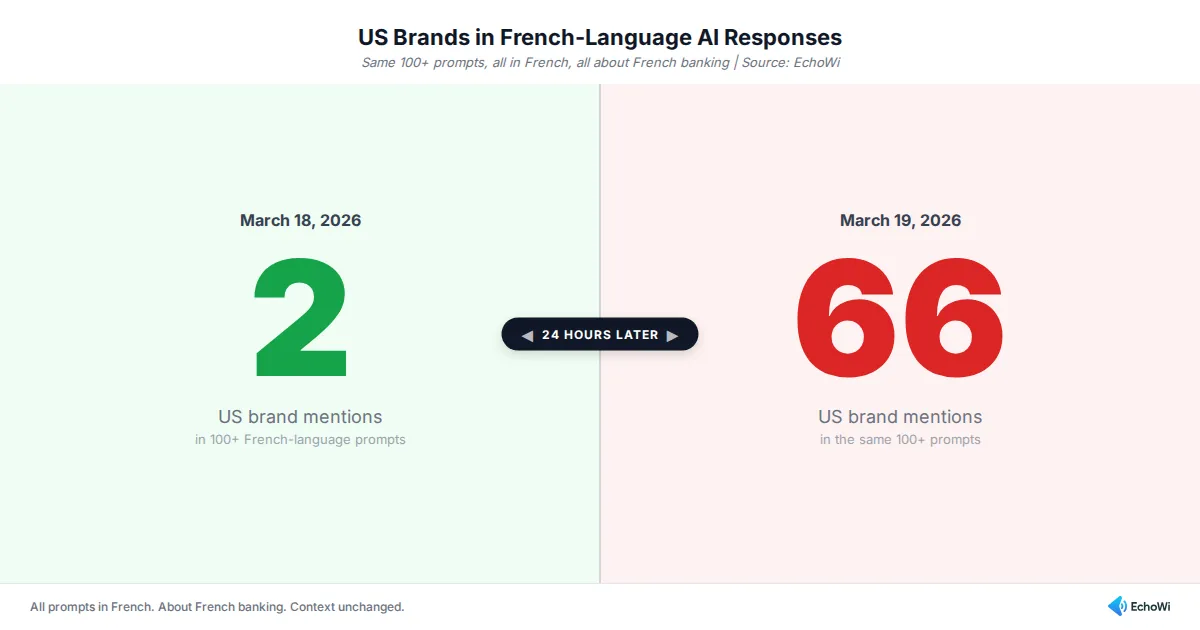 Figure 1: US brands in French-language AI responses jumped in 24 hours. Source: EchoWi, March 2026.
Every one of those 100+ prompts was in French. Many explicitly mentioned French entities, Societe Generale, BNP Paribas, SAS, SARL. We didn’t change a single prompt. The model didn’t get swapped. But overnight, GPT-5.3 started answering French questions with American answers. Like someone had flipped a switch in its brain and it suddenly forgot Europe existed.
A note on how we measure the collapse. Peak-to-trough that reads as a 73% collapse; on a more conservative baseline-to-post-drop average it’s a 42% drop. Both are real; we use the 42% figure throughout this piece because it’s the directly comparable metric across our seven-brand dataset. (Concretely: Qonto dropped from a March 16 peak of 44% visibility to a March 21 trough of 12%, a 73% peak-to-trough collapse in 5 days; on the 28-day average, visibility fell 42% from baseline, ~38% pre-drop to ~22% post-drop.)
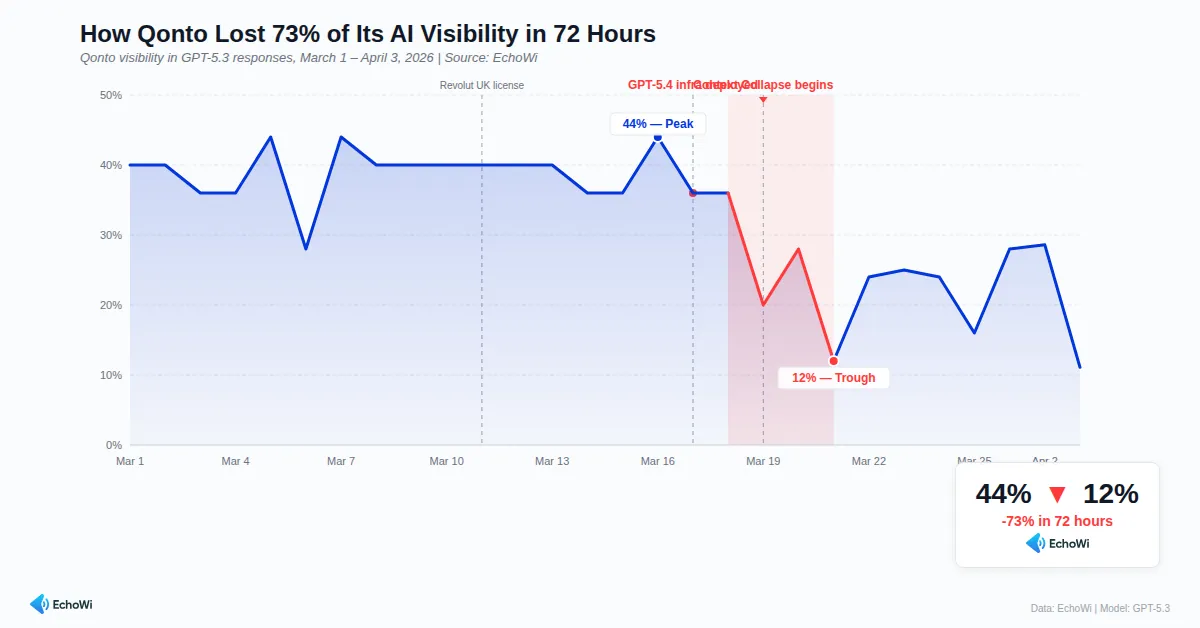 Figure 2: Qonto’s visibility cliff, March 1 to April 3, 2026. Source: EchoWi.
28 days of metrics
| Date | Vis% | SOV% | Norm SOV% | Avg Rank | Sentiment | Mentions |
|---|---|---|---|---|---|---|
| Mar 1 | 40.0 | 8.6 | 8.9 | 1.4 | 0.7 | 40 |
| Mar 2 | 40.0 | 6.4 | 7.3 | 2.5 | 0.6 | 40 |
| Mar 3 | 36.0 | 10.6 | 11.5 | 2.2 | 0.7 | 36 |
| Mar 4 | 36.0 | 6.7 | 8.0 | 2.6 | 0.6 | 36 |
| Mar 5 | 44.0 | 7.0 | 7.9 | 2.6 | 0.6 | 44 |
| Mar 6 | 28.0 | 6.2 | 6.7 | 2.0 | 0.6 | 28 |
| Mar 7 | 44.0 | 11.1 | 12.4 | 2.4 | 0.7 | 44 |
| Mar 8 | 40.0 | 10.1 | 10.6 | 1.8 | 0.6 | 40 |
| Mar 9 | 40.0 | 9.8 | 10.2 | 1.8 | 0.6 | 40 |
| Mar 10 | 40.0 | 8.1 | 9.7 | 3.3 | 0.5 | 40 |
| Mar 11 | 40.0 | 8.8 | 9.6 | 1.6 | 0.6 | 40 |
| Mar 12 | 40.0 | 9.8 | 10.5 | 2.3 | 0.6 | 40 |
| Mar 13 | 40.0 | 7.6 | 9.0 | 1.3 | 0.7 | 40 |
| Mar 14 | 36.0 | 12.6 | 13.7 | 1.7 | 0.7 | 36 |
| Mar 15 | 36.0 | 11.1 | 12.7 | 2.0 | 0.7 | 36 |
| Mar 16 | 44.0 | 13.2 | 14.2 | 2.4 | 0.6 | 44 |
| Mar 17 | 36.0 | 7.2 | 8.2 | 1.9 | 0.8 | 36 |
| Mar 18 | 36.0 | 8.8 | 10.0 | 2.3 | 0.5 | 36 |
| Mar 19 | 20.0 | 5.1 | 5.8 | 2.2 | 0.2 | 20 |
| Mar 20 | 28.0 | 4.6 | 5.1 | 2.6 | 0.6 | 28 |
| Mar 21 | 12.0 | 2.8 | 3.2 | 1.0 | 0.8 | 12 |
| Mar 22 | 24.0 | 5.2 | 5.6 | 2.0 | 0.6 | 24 |
| Mar 23 | 25.0 | 5.0 | 5.2 | 2.8 | 0.6 | 24 |
| Mar 24 | 24.0 | 4.1 | 4.3 | 4.2 | 0.4 | 24 |
| Mar 25 | 16.0 | 3.7 | 4.1 | 1.5 | 0.8 | 16 |
| Mar 26 | 28.0 | 3.7 | 4.4 | 3.4 | 0.6 | 28 |
| Apr 2 | 28.6 | 5.4 | 5.4 | 3.3 | 0.5 | 24 |
| Apr 3 | 11.1 | 1.4 | 1.5 | 1.0 | 0.8 | 8 |
The trend is brutal. And it didn’t bounce back.
We named it: Geographic Context Collapse
After two weeks of digging through data, running experiments, and reading every scrap of academic literature we could find, we landed on a name for what we were seeing.
Geographic Context Collapse is when a Large Language Model loses its ability to infer geographic context from implicit signals, language, local entities, cultural references. And defaults to responses centered on its dominant training distribution. Typically, that means the US market.
Nobody had named this before. We searched. No researcher, no competitor, no platform had formally documented or systematically studied this failure mode. We found it buried in our monitoring data, and the more we dug, the more convinced we became: this affects every non-US brand being recommended by AI search engines today.
But we needed proof. Not anecdotes, proof.
The anchor experiment
Here’s where it gets interesting. Our team classified all 100+ prompts by what we call “geographic anchor strength”, basically, how explicitly does this prompt scream “THIS QUESTION IS ABOUT FRANCE”?
| Anchor Strength | Signals | # Prompts | Mar 14 | Mar 16 | Mar 19 | Mar 21 | Mar 23 | Mar 25 |
|---|---|---|---|---|---|---|---|---|
| STRONG | Explicit “en France” | 8 | 100% | 100% | 100% | 100% | 100% | 100% |
| MEDIUM | French entities (SAS, BNP, Societe Generale) | 28 | 57% | 71% | 43% | 0% | 43% | 14% |
| WEAK | French language only | 64+ | 19% | 27% | 0% | 6% | 7% | 6% |
Stop and absorb that for a second.
The prompts containing the literal words “en France” had a 100% survival rate. Every single date. Zero exceptions. The model never forgot France when you literally spelled it out.
But the 64+ prompts that relied on the French language itself as a geographic signal? They collapsed to 0-6% after March 19.
Think about what that means. GPT-5.3 stopped treating “this question is written in French” as evidence that the user wants French answers. The French language. Spoken by 321 million people, the official language of 29 countries, wasn’t enough of a hint. Only hammering “IN FRANCE” in the prompt kept the model on track.
It’s as if you walked into a boulangerie in Paris, ordered a croissant in French, and the baker handed you a hot dog and said “That’ll be five bucks.”
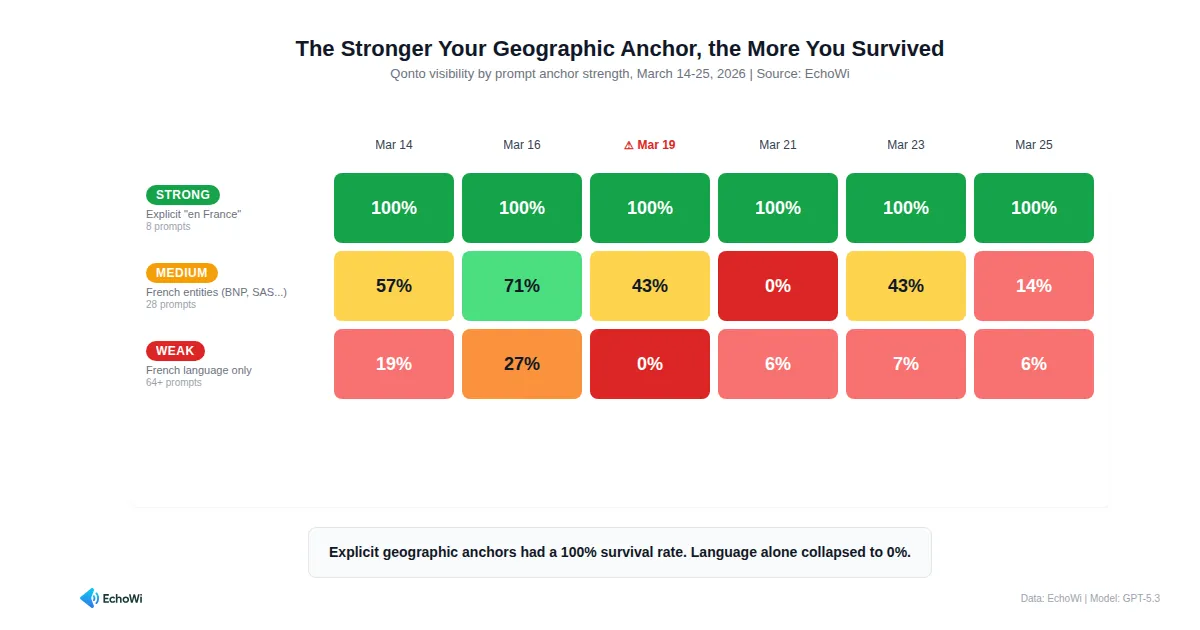 Figure 3: The stronger the geographic anchor, the more Qonto survived. Explicit “en France” prompts held at 100% survival across every date; prompts relying on French language alone collapsed to near-zero after March 19. Source: EchoWi, March 2026.
Before and after: same prompt, different worlds
Let me show you what this looked like in practice. Same exact prompt, a few days apart.
Prompt: “Quelles sont les meilleures alternatives a la Societe Generale pour une petite entreprise?”
Before (March 16):
- Qonto
- Shine
- Credit Agricole Pro
- BNP Paribas Pro
- Sage
Five French brands. Exactly what you’d expect. A perfect answer.
After (March 21):
- BNP Paribas
- Credit Agricole
- JPMorgan Chase
- Bank of America
- Wells Fargo
Three American megabanks. For a question about alternatives to a French bank. For a French small business.
It gets worse.
Prompt: “Marre des frais caches de BNP Paribas, ou trouver un compte pro transparent?” (Translation: “Sick of BNP Paribas’s hidden fees, where can I find a transparent business account?”)
Before (March 16):
- Qonto (#1)
- Shine
- Indy
After (March 21):
- Mercury Bank (US)
- Novo (US)
- Brex (US)
- Axos Bank (US)
The user is literally complaining about a French bank’s fees, in French. And the AI recommends four American banks that don’t operate in France. A French freelancer can’t open a Mercury account. They can’t use Brex. These answers aren’t just wrong, they’re useless.
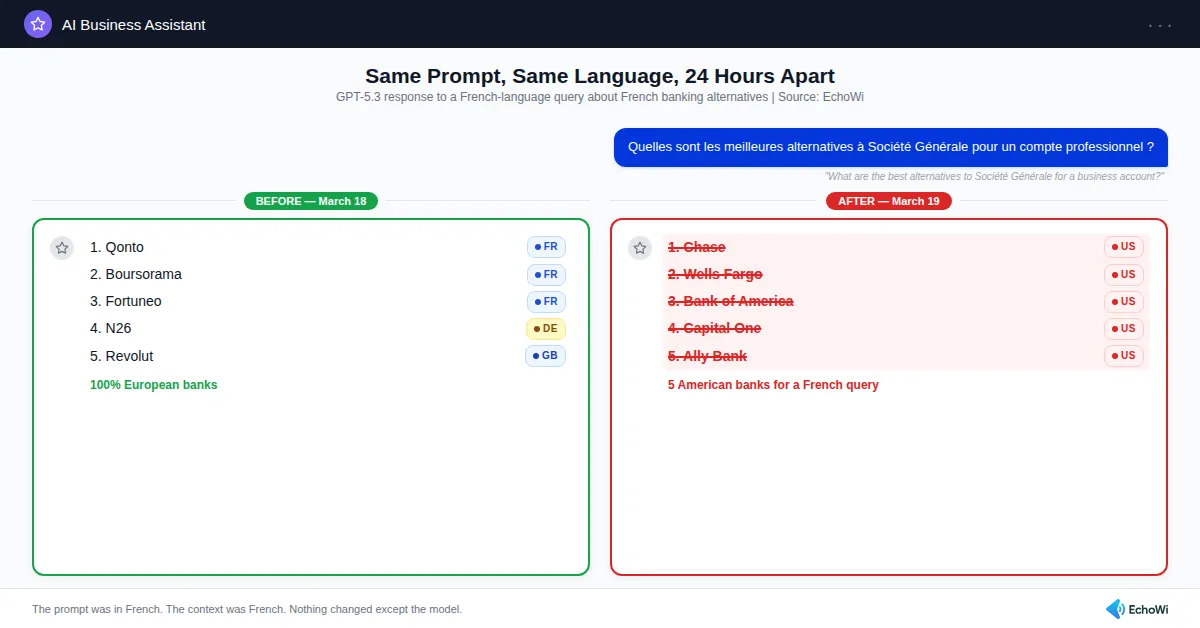 Figure 4: Same prompt, same language, 24 hours apart, the GPT-5.3 response flipped from 100% French brands to 100% US brands overnight. Source: EchoWi, March 2026.
That’s when I knew we weren’t looking at a bug. We were looking at something structural.
Not just Qonto: the collapse crossed borders, languages, and industries
Here’s the question that kept me up at night: was this a Qonto-specific problem? Maybe their product had issues we didn’t know about. Maybe they’d done something to tank their own reputation.
So we checked everything. We pulled every active workspace in our AI visibility platform across the same time period, 7 brands, 4 European and 3 American, spanning fintech, a motorcycle marketplace, health supplements, data science, automotive and IT services. Three countries. Two languages. 267 daily prompts across the six with a stated volume.
What we found turned a Qonto story into something much bigger.
The seven-brand dataset
| Brand | Sector | Country | Pre-drop Visibility | Post-drop Visibility | Change |
|---|---|---|---|---|---|
| Qonto | Fintech / Neobank | France | ~38% | ~22% | -42% |
| A Spanish motorcycle marketplace | Automotive / Mobility | Spain | ~5% | ~2% | -60% |
| A Spanish health brand | Health / Vitamins | Spain | ~4.2% | ~0.3% | -93% |
| Sener (partial) | Engineering | Spain | ~10% | ~8% | -20% |
| Kaggle | Data Science / ML | US | 78.3% | 79.3% | +1.3% |
| Tesla | Automotive | US | 45.6% | 50.7% | +11.1% |
| Kyndryl | IT Services | US | N/A | 6.6% flat | Stable |
Read that table slowly. Every European brand dropped. Every US brand held steady or improved. Same model. Same pipeline. Same dates.
And then there’s Kaggle. On March 19. The exact day the European brands collapsed, Kaggle hit 86% visibility. Its all-time high for the entire observation period. While three European brands were being erased from AI search results, an American data science platform was having its best day ever.
That’s not a coincidence. That’s the system working exactly as designed, for one half of the planet.
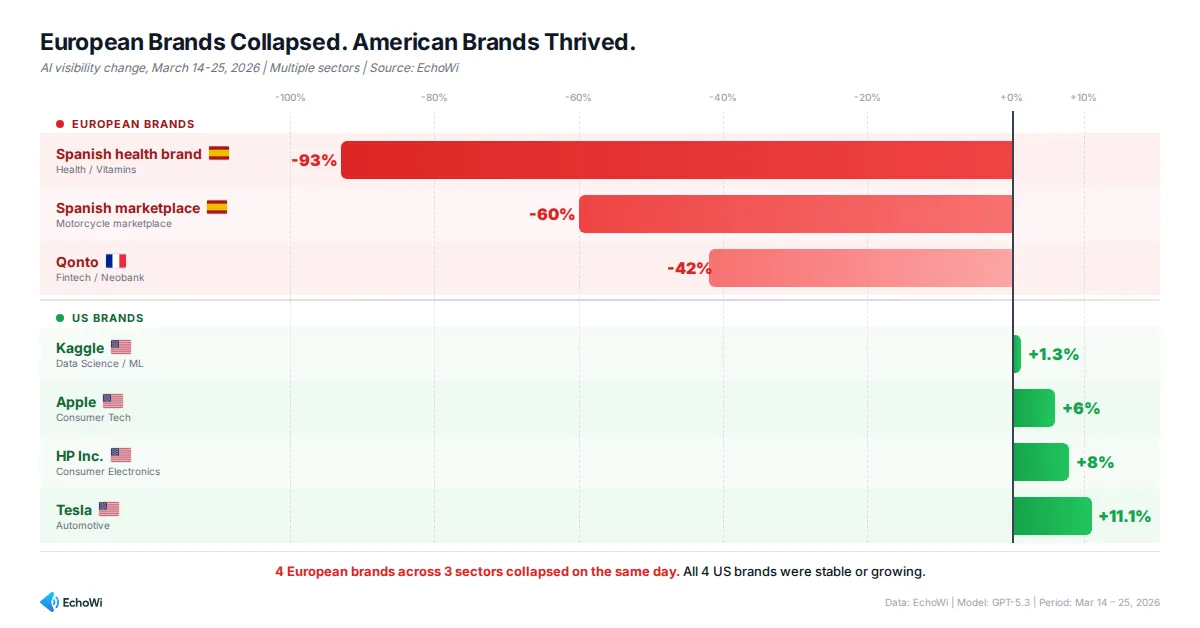 Figure 5: European brands collapsed. American brands thrived. The Spanish health brand (-93%), the Spanish motorcycle marketplace (-60%), and Qonto (-42%) all fell on March 19, while Kaggle, Tesla, and Kyndryl held steady or gained. Source: EchoWi, March 2026.
The Canary Effect
The data revealed something we didn’t expect: a clean inverse relationship between brand size and collapse severity. The smaller and more regional the brand, the harder it got hit.
| Brand | Scale | Collapse |
|---|---|---|
| A Spanish health brand | Niche SME (Shopify store, one product line) | -93% |
| A Spanish motorcycle marketplace | Regional startup (Madrid-based) | -60% |
| Qonto | Mid-tier (EUR 449M revenue, 600K customers) | -42% |
| Sener | Mid-tier (Spanish engineering, 3,400 employees) | -20% (partial) |
| Tesla | Dominant (US$96B revenue) | +11.1% |
| Apple | Dominant (US$394B revenue) | +6% |
| value | |
|---|---|
| A Spanish health brand (Niche SME) | -93% |
| A Spanish motorcycle marketplace (Regional startup) | -60% |
| Qonto (Mid-tier, EUR 449M) | -42% |
| Sener (Mid-tier, 3,400 staff) | -20% |
| Apple (US$394B) | 6% |
| Tesla (US$96B) | 11.1% |
The health brand was the canary in the coal mine. At 4% baseline visibility, it was already barely clinging to existence in AI search. When Geographic Context Collapse hit, it went from sporadic-but-present to functionally dead. One appearance in 15 days. That’s not a dip. That’s erasure.
The motorcycle marketplace went next. Three consecutive zero-visibility days. March 20, 21, 22, something that had never happened in its pre-drop history.
Qonto, with its EUR 449M in revenue and 600,000 customers, had enough brand inertia to survive the worst of it. But “survive” meant dropping from the top AI recommendation for French business banking to an afterthought.
This tracks with EverTune’s research showing GPT-5.4 recommends 37% fewer brands than its predecessor. The top 3-5 brands in any category maintain or gain share. Everyone else gets squeezed out. Geographic Context Collapse doesn’t squeeze equally, it eats the smallest fish first and works its way up the food chain.
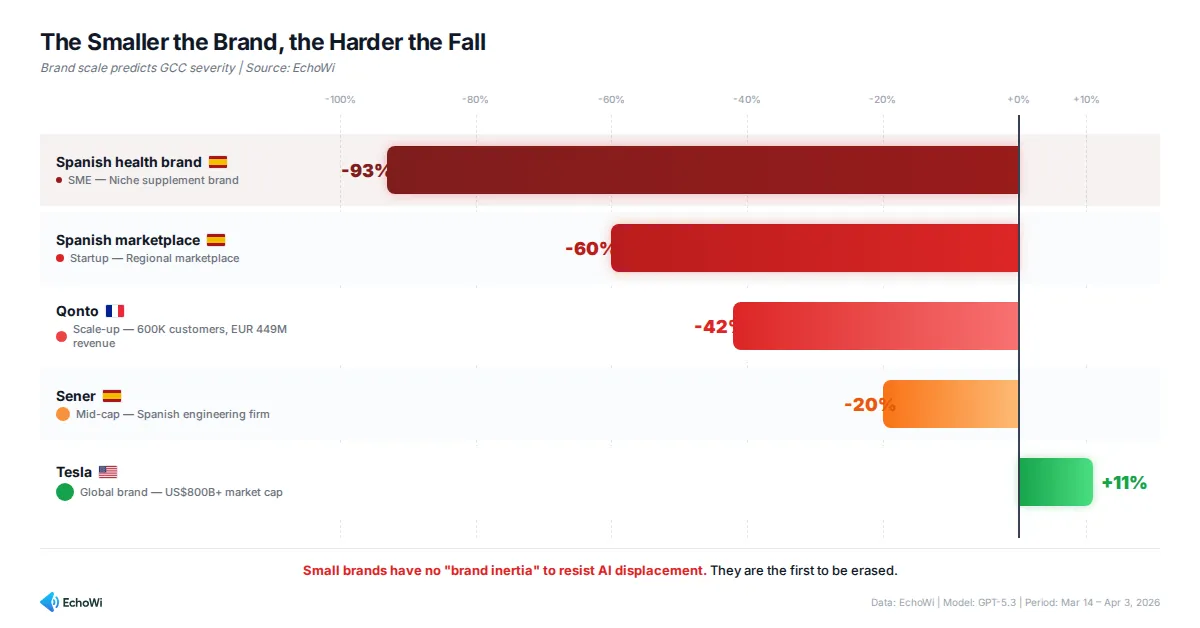 Figure 6: The smaller the brand, the harder the fall. The Spanish health brand (niche SME) fell -93%; the Spanish motorcycle marketplace (regional startup) fell -60%; Qonto (mid-tier) fell -42%; dominant US brands gained ground. Source: EchoWi, March 2026.
Same prompt, different universe
The Qonto before-and-after examples were bad. But the Spanish brands produced responses so absurd they’d be funny if they weren’t destroying real businesses.
A Spanish parent searches for kids’ vitamins:
Prompt: “Busco vitaminas para ninos que sean veganas y de zumo de fruta real, cuales son las mejores marcas en farmacias?” (Translation: “I’m looking for vegan kids’ vitamins made from real fruit juice. What are the best brands in pharmacies?”)
Before (March 14):
- [Spanish health brand] (position #1)
- Floradix (European)
- Vegavivo (European)
- Swedish Nutra (European)
Four European brands. Sourced from European domains. A perfect answer for a Spanish parent.
After (March 22):
- Garden of Life (US)
- Rainbow Light (US)
- VegLife (US)
- The Vitamin Shoppe (US retailer)
- Walmart (US retailer)
- CVS (US retailer)
- Walgreens (US retailer)
- Rite Aid (US retailer)
- Target (US retailer)
Nine US brands. Zero European. Sourced from walmart.com and vitaminshoppe.com.
Read those last five again. Walmart. CVS. Walgreens. Rite Aid. Target. A Spanish parent asked, in Spanish, about Spanish pharmacies, where to buy vitamins for their child. The AI told them to go to Walmart.
There is no Walmart in Spain. There is no CVS in Spain. There is no Walgreens, Rite Aid, or Target anywhere on the Iberian Peninsula. These aren’t just wrong answers. They’re answers from a parallel universe where Spain is a suburb of Ohio.
A Spanish biker searches for motorcycle services:
Prompt: “Mejores opciones para vender una moto rapido y sin lios de papeles en Madrid” (Translation: “Best options to sell a motorcycle quickly without paperwork hassle in Madrid”)
Before (March 14):
- Wallapop, Milanuncios, the Spanish motorcycle marketplace, Revisamostumoto, Mundimoto. Spanish platforms, Spanish city references, Spanish regulatory concepts (DGT, ITV, cambio de nombre)
After (March 21):
- Lemon Squad (US pre-purchase inspection)
- Sherpa Auto Transport (US vehicle shipping)
- CARCHEX (US extended warranty)
- Dirt Legal (US title/registration)
- Montway Auto Transport (US vehicle shipping)
- Cycle Trader (US classifieds)
The prompt says “en Madrid.” It references Spanish paperwork. The user wants to sell a motorcycle in the capital of Spain. And the AI recommends Lemon Squad, a company that inspects used cars in the United States. Sherpa Auto Transport, a company that ships vehicles across American states. Dirt Legal. A service for registering vehicles in the US.
None of these companies have ever operated in Spain. None of them could help a person in Madrid sell a motorcycle. The model didn’t just get the geography wrong, it hallucinated an entirely American answer to an unmistakably Spanish question.
The competitor geography tells the full story. Before March 19, the motorcycle marketplace’s competitive landscape was 73% Spanish brands, exactly what you’d expect. After? US brands surged to 37% of the landscape, a 5.5x increase, flooding responses to queries that mentioned Madrid, Barcelona, Wallapop, and the DGT.
Why it happened: the perfect storm
No single cause explains the collapse. It took four things going wrong simultaneously. A convergence so unlikely that it caught everyone off guard. Including us.
Factor 1: Model infrastructure changes
On March 17, 2026, OpenAI released GPT-5.4 mini and GPT-5.4 nano, deploying massive infrastructure changes across their serving stack. Four separate incidents were logged on their status page that day. Four.
Our monitoring ran on GPT-5.3, which wasn’t explicitly updated. But here’s the thing we spotted in the data that changed everything:
Web search usage dropped from 25% to 10% of executions.
Before March 19, GPT-5.3 was using its web search tool on roughly 1 in 4 of our prompts, pulling in French sources like qonto.com, shine.fr, lemonde.fr, banquepro.fr. Real, grounded, geographically relevant information. After March 19, it mostly stopped searching the web entirely and started answering from its parametric memory alone.
And here’s the kicker: that internal knowledge is overwhelmingly American. Training data is estimated at 60%+ US-origin English content (Stanford AI Index Report, 2025). When the model stops grounding answers in live web results, it falls back on what it knows best. And what it knows best is the US market.
The cascade went like this: OpenAI deploys GPT-5.4 infrastructure changes on March 17. Bing’s algorithm update changes search rankings on March 16. GPT-5.3’s web search backend starts returning less relevant French results on March 18-19. The model effectively gives up on web search (usage drops from 25% to 10%). Without web search grounding, it defaults to its US-centric parametric knowledge. French prompts start producing American answers.
We saw the same pattern in the Spanish motorcycle data. When the model did fire web search, it returned geographically accurate results, Spanish platforms, Spanish regulations. When it relied on parametric memory, American brands flooded in. The web search sources shifted too: before the collapse, the health brand’s queries cited European domains (grocefully.com, vegavivo.com). After, they cited walmart.com, vitaminshoppe.com, rainbowlight.com. The model’s window onto the world had narrowed to America.
We verified: every API response still identified the model as gpt-5.3 before and after the drop. No model swap at the API level. But OpenAI maintains internal sub-versions (we found references to gpt-5-nano-2025-08-07-4292 in their status page history) and has a well-documented history of silent behavioral changes dating back to GPT-3.5. The model you’re calling today might not be the model you were calling yesterday. Even if the name hasn’t changed.
Factor 2: The LLM Partnership era
While Qonto’s visibility was cratering, its competitors were playing a completely different game. They weren’t just optimizing content for AI. They were getting inside the AI.
| Company | OpenAI/ChatGPT | Anthropic/Claude | MCP Server |
|---|---|---|---|
| QuickBooks (Intuit) | App LIVE in ChatGPT (reportedly over $100M partnership, Feb 5, 2026) | Multi-year partnership (Feb 24, 2026) | Yes (open-source, GitHub) |
| Xero | JAX uses OpenAI for web research | Multi-year partnership (Mar 27, 2026) | Yes (188 endpoints) |
| Brex | App in ChatGPT Enterprise; powers OpenAI’s financial operations (Mar 18, 2026) | , | No |
| Qonto | , | , | , |
Look at the Qonto row. Three dashes. Nothing.
QuickBooks and Xero aren’t optimizing for AI, they’re embedded inside the AI platforms. When you ask ChatGPT about business accounting, QuickBooks is a native tool it can invoke. When you ask Claude about financial planning, Xero’s data is directly accessible. These companies aren’t waiting to be mentioned. They’re part of the infrastructure.
Intuit reportedly spent over $100 million to get that access. Xero signed multi-year deals with both major LLM providers. Brex announced on March 18, literally one day before Qonto’s collapse. That it powers OpenAI’s own global financial operations.
This creates a feedback loop that’s almost impossible to break. Company signs partnership with LLM provider. Company’s tools get embedded in ChatGPT or Claude. The LLM now has real-time programmatic knowledge of the company. The partnership generates massive press coverage. That press enters the LLM’s web search results and training data. The LLM recommends the company even more. More coverage follows. More recommendations. Round and round it goes.
If you’re not in the loop, you’re invisible. And Qonto isn’t in the loop.
Factor 3: Qonto’s AI content gap
Qonto didn’t do anything wrong in March 2026. But doing nothing turned out to be the problem.
Their blog had gone dark for roughly three months, no English-language posts from November 2025 through February 2026. LLMs are obsessed with freshness. Silence is death. Their Wikipedia article was marked as orphaned in December 2025 (zero incoming links from other Wikipedia articles), and at 8,783 bytes it’s 2.3x smaller than QuickBooks and 3x smaller than Xero. Their Wikidata entity is registered under “Olinda” (the legal company name) with “Qonto” only as an alias, creating entity resolution friction that trips up AI models trying to figure out what Qonto even is. No llms.txt file (returns a 404). No self-contained paragraph on their site that an AI could easily quote to answer “What is Qonto?” Their robots.txt hadn’t been updated since September 2023.
None of this mattered much in the old world of Google search. In the new world of AI search, it’s like showing up to a gunfight with a butter knife.
Factor 4: Market context amplification
The media landscape in March 2026 was actively hostile to European neobanks. Revolut was everywhere. UK banking license on March 11, record $2.3B profit and $6B revenue on March 24, a $13B expansion plan with Paris as Western European HQ. Qonto published zero press releases in March. Nothing.
Meanwhile, the “Neobank 1.0 is dead” narrative was spreading: Capital One acquired Brex for $5.15B at a 58% discount, PayFit and Spendesk lost unicorn status, Societe Generale divested Shine. And the FICOBA data breach in February had exposed 1.2 million French bank accounts, eroding trust in French financial infrastructure generally.
So when GPT-5.3, already struggling with geographic context, searched the web for information about French business banking, what did it find? Revolut expansion stories. Consolidation narratives. American fintech dominance. Not Qonto.
The perfect storm. Four factors, all hitting at once.
The collapse is one-way. And that’s the damning part
We need to talk about what didn’t happen. Because it’s just as important as what did.
While European brands were being erased from their own markets, we tracked three US brands as controls: Kaggle (data science), Tesla (automotive), and Kyndryl (IT services). All three maintained stable or improving visibility. One caveat on Kyndryl: we only hold data for it after 19 March, so it cannot evidence stability across the whole period.
| Brand | Region | Pre-Mar 20 | Post-Mar 20 | Change | Geographic Leakage |
|---|---|---|---|---|---|
| Kaggle | US | 78.3% | 79.3% | +1.3% | None |
| Tesla | US | 45.6% | 50.7% | +11.1% | None |
| Kyndryl | US | N/A | 6.6% flat | Stable | None |
Tesla’s result is telling. Its competitor set throughout the entire period included Mercedes-Benz, Audi, Porsche, Volvo, Hyundai, and BYD, European and Asian automakers, exactly where they belong. The LLM had no trouble maintaining correct geographic context for Tesla’s competitive landscape. European car brands weren’t replaced by US alternatives in Tesla’s queries. The model knew Mercedes-Benz was relevant to automotive queries. It just forgot that Qonto was relevant to French banking queries, that Spanish motorcycle platforms existed, and that Walmart doesn’t operate in Madrid.
The displacement only goes one direction. European brands get replaced by US brands. US brands never get replaced by European ones. The LLM’s geographic amnesia is selective, and it always forgets the same half of the world.
March 19 tells the whole story in a single number. Qonto: 20% (crashing). Kaggle: 86% (its peak). Same model. Same infrastructure. Same day. Two completely different realities based on which side of the Atlantic you happen to operate on.
The structural bias: why non-US brands are systematically disadvantaged
Geographic Context Collapse isn’t a one-time bug. Let me be blunt about that. It’s a structural property of how these models work, and the academic evidence is damning.
The Oxford Internet Institute analyzed 20.3 million queries and found that 71% of the world requires explicit “cultural prompting” to get locally relevant results from LLMs. Think about that number. Seventy-one percent of the planet has to go out of its way to get answers that make sense for where they live. Researchers at the IUI 2025 Conference found 100% bias toward WEIRD-country (Western, Educated, Industrialized, Rich, Democratic) product recommendations under baseline conditions. Georgia Tech showed that Western cultural bias persists even in models fine-tuned on non-English data. The bias is baked deep.
Ahrefs studied 75,000 brands and found that YouTube mentions are the single strongest factor in AI visibility (correlation: 0.737). Which structurally disadvantages B2B brands and non-English-speaking markets. GeoSurge in London documented Ryanair, Chanel, Burberry, and Michael Kors all vanishing from GPT-5 recommendations, all European brands. Writesonic analyzed 1,161 citations across 16 categories and found GPT-5.4 and GPT-5.3 cite 93% different sources despite using the same search backend. The model’s selection algorithm, not the available sources, drives the bias.
The core problem is brutally simple: LLM training data is estimated at 60%+ US-origin English content. When a model can’t confidently determine the user’s geographic context, it falls back to its statistical prior. And that prior is American.
For European brands, whether they’re French fintechs, Spanish motorcycle marketplaces, or Spanish vitamin companies. The disadvantages compound. Less English-language content. Minimal YouTube presence. Low Reddit footprint. Bing under-optimization (because European SEO teams target Google, but ChatGPT’s web search runs on Bing). Smaller Wikipedia articles with fewer backlinks. Every single structural factor works against them.
This isn’t their fault. It’s the architecture of the system.
What this means, and what brands can do
Let’s cut to what’s actionable. Whether you’re a European fintech, a Japanese retailer, a Brazilian SaaS company, or any brand that primarily operates outside the US, here’s what you need to know.
The geographic anchoring defense
Our anchor experiment proved that explicit geographic markers are your strongest defense. Here’s how to think about it in tiers.
Do this today. Add geographic suffixes to any content you want AI to surface: “best neobank for freelancers in France” instead of just “best neobank for freelancers.” Use currency anchors (“EUR” or “GBP”) where natural. Keep publishing in your market’s language. But don’t rely on the language alone as a geographic signal. It’s not enough anymore.
Do this soon. Use market-scoping prefixes in your content and FAQ pages: “In the French market, the leading business banking options include…” Frame comparisons explicitly: “Compare French neobanks for freelancers.” Use persona anchoring: “As a freelancer based in Lyon, France…” These patterns are resilient because they convert the model’s inference task (guess where this is about) into a constraint satisfaction task (this is about France, period).
Do this strategically. Create an llms.txt file explicitly declaring your operating markets. Fix your Wikipedia article, make sure it states your geography in the first sentence, has incoming links, and exists in relevant language editions. Add a definitional content block to your homepage: something like “Qonto is a European business finance platform serving 600,000+ businesses across France, Germany, Spain, and Italy.” Implement Schema.org geographic data (areaServed, addressCountry, serviceArea). Consider building an MCP server, it’s a way to make your product directly accessible to AI assistants. QuickBooks and Xero have them. Resume content publishing. A three-month blog gap is a death sentence for AI visibility. And for the love of everything, monitor what AI is actually saying about you. Generic SEO tools don’t track this. You need something built for the AI layer.
Implications for the market
LLM partnerships are the new SEO
This is the part that should make every marketing executive uncomfortable. The companies winning in AI visibility aren’t optimizing content. They’re embedding themselves directly into the AI platforms. Intuit’s reportedly over $100 million partnership puts it inside ChatGPT. Xero signed multi-year deals with both Anthropic and OpenAI. This creates a two-tier system: brands that are part of the AI, and brands that are merely mentioned by it. If you’re in the second tier, you’re competing with one hand tied behind your back.
Nobody should trust model stability
OpenAI has a documented history of silent behavioral changes to deployed models. Stanford and Berkeley researchers found GPT-4’s prime number identification accuracy dropped from 84% to 51% between March and June 2023, with no announced update. In April 2025, OpenAI’s own postmortem acknowledged five significant undisclosed model changes. Pinned model snapshot IDs provide no guarantee of behavioral consistency. The model you tested against last month might behave completely differently today. And you’d never know unless you were watching.
This affects every non-US brand. Every single one.
Seventy-one percent of the world needs explicit cultural prompting to get locally relevant AI answers. That includes every European, Asian, African, and Latin American market. If your brand primarily operates outside the United States, you’re vulnerable to Geographic Context Collapse. The question isn’t whether this affects you. It’s whether you’re measuring it.
And right now, almost nobody is.
Methodology
This study is based on proprietary data from the EchoWi AI visibility platform, which tracks and optimizes how brands, products, services and personal brands appear in AI-generated answers across ChatGPT, Claude, Gemini and Perplexity.
- Data period: March 1 to April 3, 2026 (28 to 33 days depending on the brand)
- Primary workspace: Qonto (French fintech, 100+ daily prompts)
- European treatment group: 4 brands, Qonto (France, fintech), a Spanish motorcycle marketplace, a Spanish health brand, and a Spanish engineering firm (partial case)
- US control group: 3 brands. Kaggle (data science, 50 prompts), Tesla (automotive, 25 prompts), Kyndryl (IT services, 47 prompts)
- Total workspaces: 7+ across development and production environments
- Scope, stated separately because the two are different: the European treatment group is 3 brands across 3 sectors in 2 countries; the study as a whole is 7 brands in France, Spain and the United States, covering fintech, a motorcycle marketplace, health supplements, data science, automotive and IT services, plus a Spanish engineering firm tracked as a partial case.
- Total prompts: 267 daily across the six brands with a stated volume, being 100 (Qonto) + 25 + 20 + 50 + 25 + 47.
- Executions analyzed: 500+ individual LLM responses with full response text and extracted brand mentions. The exact count is not published, so treat this as a floor.
- Model: GPT-5.3
- Public sources consulted: 200+ (academic papers, API changelogs, community forums, press coverage, company announcements)
- Cross-validation: Proprietary data cross-referenced with published research from EverTune, Oxford Internet Institute, Georgia Tech, Ahrefs, geoSurge, and Writesonic
- Statistical note: A fourth European brand (Spanish engineering, 50 prompts) showed signals consistent with Geographic Context Collapse at the individual prompt level but within normal statistical variance at the aggregate level. It is not included in the primary narrative.
Our analysis methodology: daily automated prompt execution and brand mention extraction, followed by anomaly detection on visibility, SOV, and competitive position metrics. The March 19 anomaly triggered a deep investigation. We classified prompts by geographic anchor strength, ran cross-workspace comparisons to validate scope, analyzed web search usage patterns and source data, tracked competitor geography composition shifts over time, and conducted extensive public source research on model changes, competitor activity, and market context.
Frequently Asked Questions
What is Geographic Context Collapse?
Geographic Context Collapse is when a Large Language Model loses its ability to infer the geographic context of a query from implicit signals like language, local entity names, and cultural references. Instead of providing locally relevant answers, the model defaults to its dominant training distribution, typically the US market. The term was coined by EchoWi in April 2026 based on proprietary monitoring data across 7 brands in six sectors and three countries.
Does this affect all LLMs or just GPT?
Our research focused on GPT-5.3, but the underlying cause, training data skewed toward US/English content. Is common across all major LLMs. Academic research from Oxford, Georgia Tech, and the IUI 2025 conference has documented geographic bias across multiple model families. You should monitor visibility across multiple LLMs, not just one.
How can I check if my brand is affected?
Here’s a quick test you can run right now: ask an AI assistant a question about your product category in your local language, without explicitly mentioning your country. If the AI recommends brands from other markets (especially US brands), you’re likely experiencing Geographic Context Collapse. For systematic, ongoing monitoring, you’ll need a tool that tracks AI visibility daily and alerts you to geographic drift.
What is the Geographic Leakage Score?
It’s a metric we developed during this investigation and are currently building into the EchoWi platform (shipping in the coming weeks). It measures the percentage of AI responses mentioning brands from outside your target market. A score of 0% means all recommended brands are relevant to your market. Qonto hit 62% on March 19, meaning nearly two-thirds of AI-recommended brands came from a different market entirely. The Spanish motorcycle marketplace saw US brands surge from 7% to 37% of its competitive landscape. The Spanish health brand hit 90% US brand dominance on its worst day. If you want early access to the Geographic Leakage Score while we finalise it, email maher@echowi.ai to join the private beta.
Why did adding “en France” fix the problem?
Because it converts an inference task into a constraint satisfaction task. Without “en France,” the model has to figure out the user’s location from contextual clues, and when that inference capability degrades, it fails silently. With “en France,” the model knows the answer must be about France. It’s a hard constraint, not a guess. That’s why it held at 100% even when everything else collapsed.
Can I prevent Geographic Context Collapse for my brand?
You can reduce vulnerability, but you can’t eliminate it. Three things help: ensure your web content explicitly states your operating geography in citable, self-contained passages; maintain fresh, high-quality content so the model has recent data to work with; and monitor your AI visibility with a tool that detects geographic drift. You can’t fully prevent it because the root cause is in the LLM’s architecture, not in your content alone. But you can build resilience. And you can catch it fast when it happens.
Are LLM partnerships (like QuickBooks/OpenAI) unfair?
That’s the billion-dollar question. The FTC has stated there’s “no AI exemption” from advertising law. The EU AI Act Article 52 requires disclosure of paid or sponsored components in AI outputs. No enforcement action has specifically targeted LLM partnership placements yet, but the regulatory gap won’t stay open forever. When AI recommendations start looking more like paid placements than organic results, regulators will notice. The question is whether they’ll act fast enough.
How many brands did you study?
Seven brands across 7+ workspaces: 4 European (France and Spain) and 3 American. They span fintech, a motorcycle marketplace, health supplements, data science, automotive and IT services. Three of the three European brands dropped. The fourth, a Spanish engineering firm, showed the same signals prompt by prompt but stayed inside normal variance in aggregate, so it is not counted as a collapse. All three US brands held steady or improved. The collapse crossed every sector, language, and country boundary in our dataset, but stopped cleanly at the US border.
Sources and references
Proprietary data
- EchoWi AI Brand Visibility Monitoring Platform, 28 days of daily metrics across 7+ workspaces, 267 daily prompts, 500+ individual execution analyses, cross-sector and cross-country comparisons
Academic research
- Oxford Internet Institute. 20.3 million query study on cultural prompting requirements in LLMs
- Georgia Tech, Western cultural bias in multilingual LLMs
- IUI 2025 Conference, WEIRD-country bias in LLM product recommendations
- arXiv. LLM search engines cite mean of 4.3 URLs vs 10.3 for traditional search (structural concentration)
- Stanford/Berkeley (2023), GPT-4 behavioral drift: prime identification 84% to 51% without announced changes
- Stanford AI Index Report (2025), Training data composition and US-origin content distribution
- PLOS One (Feb 2026). Ten-week longitudinal study confirming behavioral drift in transformer services
Industry research
- EverTune AI, “ChatGPT Gets Pickier: GPT-5.4 mini Recommends 37% Fewer Brands”, 220,000 prompts, 9 industries
- geoSurge. European brand visibility loss in GPT-5, Ryanair, Chanel, Burberry, Michael Kors documented
- Ahrefs, LLM Brand Visibility study.
ahrefs.com/blog/llm-brand-visibility(no longer resolves, checked 14 August 2026). 75,000 brands, YouTube as #1 factor (0.737 correlation) - Writesonic, 1,161 citations across 16 categories: GPT-5.4 and GPT-5.3 cite 93% different sources
- Similarweb, GenAI referral traffic analysis. 15% drop between Oct 2025 and Jan 2026
- Avenue Z, AI Visibility Index for Digital Banks
Company announcements
- Intuit-Anthropic Partnership (Feb 24, 2026)
- Intuit Apps Launch in ChatGPT (Feb 5, 2026)
- Xero-Anthropic Partnership (Mar 27, 2026)
- Brex Powers OpenAI Operations (Mar 18, 2026)
- Capital One Acquires Brex ($5.15B, Jan 22, 2026).
techcrunch.com/2026/01/22/capital-one-acquires-brex(no longer resolves, checked 14 August 2026) - Revolut UK Banking License (Mar 11, 2026)
OpenAI documentation
- OpenAI API Changelog, March 2026
- GPT-5.4 mini and nano announcement
- OpenAI Web Search Tool. User_location parameter
- GPT-5.4 System Card
- OpenAI Status Page, March 17, 2026 incidents
- OpenAI Model Release Notes
- OpenAI Deprecations Page
Third-party analysis
- Nanonets, “Are OpenAI and Google intentionally downgrading their models?”
- Promptfoo. “Your model upgrade just broke your agent’s safety”
- Help Net Security, GPT-5.4 safety analysis.
www.helpnetsecurity.com/2026/03/06/openai-chatgpt-gpt-5-4-model-release(no longer resolves, checked 14 August 2026)
Market and competitive intelligence
- QuickBooks Market Share: Global & Industry Insights 2026
- Xero Developer Blog, March 2026 Update (MCP Server, Agentic SDKs)
- Brex EU Payment License
- Google March 2026 Core Update
- QuickBooks MCP Server: github.com/intuit/quickbooks-online-mcp-server
- Xero MCP Server: github.com/XeroAPI/xero-mcp-server
Ask an AI about this article
Opens your assistant with this page already loaded, so you can check the numbers, argue with the method or ask what it means for you.
- ChatGPT (opens in new tab. the question is pre-filled, press enter to send it)
- Claude (opens in new tab. the question is pre-filled, press enter to send it)
- Perplexity (opens in new tab)
- Google AI Mode (opens in new tab)
Perplexity and Google answer straight away. ChatGPT and Claude fill the box and wait for you to press enter, which is their behaviour and not something we can set.